UIUC Cozad New Venture Challenge
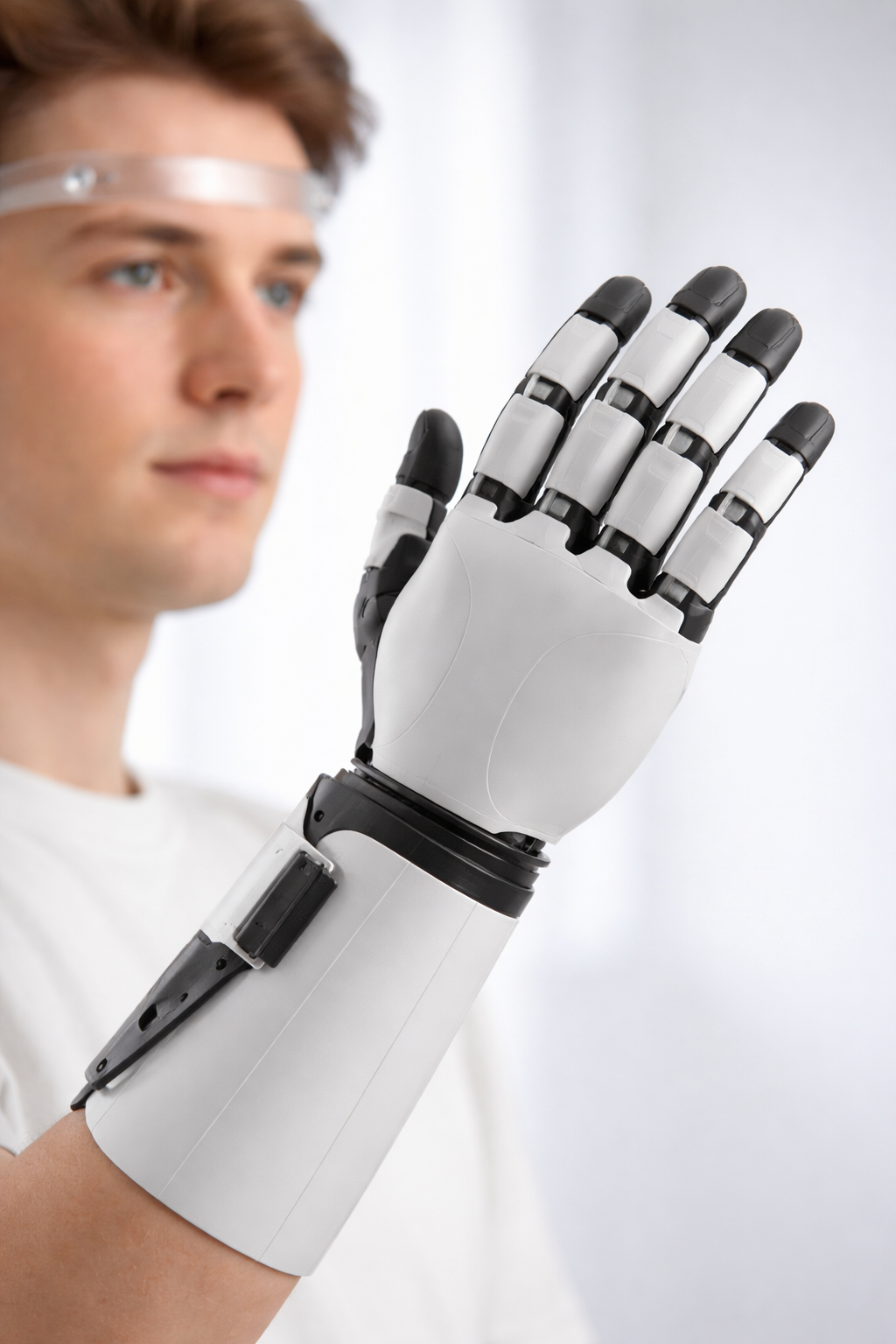
A multi-grip prosthetic hand that reads your eye and muscle signals and responds in real time. Built to be affordable for everyone.
Advanced prosthetics cost tens of thousands of dollars. That's not
a technology problem. It's a priority problem. We're fixing it.
We read biosignals from your eyes and muscles, decode your intent, and act on it in real time.
A lightweight headband reads electrooculography signals from your eye movements. Deliberate blink patterns, single, double, or long, select and switch between grip modes without moving a muscle in your arm.
Surface electrodes on the residual upper arm pick up the electrical activity of your muscles. Those signals are filtered, amplified, and digitized to measure the strength and direction of your intended movement.
Both streams merge inside a compact embedded processor. A trained classifier figures out which grip you want, power, pinch, tripod, or lateral, and sends the command wirelessly to the prosthetic in under 200ms.
EOG and EMG electrodes pick up microvolt-level electrical signals from the eye muscles and residual limb.
Instrumentation amplifiers and bandpass filters clean and scale the raw signals before they're digitized.
An on-device model fuses both streams and classifies which grip the user wants, all in real time, with no cloud dependency.
Commands go out over BLE to the embedded controller in the prosthetic, which actuates the fingers.
State-of-the-art prosthetic hands cost between $20,000 and $100,000. Insurance rarely covers them. The people who need these devices the most are the ones least able to afford them.
Lotus Bionics pairs 3D-printed hardware with intelligent biosignal control to deliver a clinically capable, multi-grip prosthetic hand at a fraction of the cost. Without compromising on what matters.
Whether you're a potential user, clinician, researcher, or investor, we want to hear from you.